

Subscribe to our newsfeed
Oleg Ustinov
born 1984, Rostov-on-Don
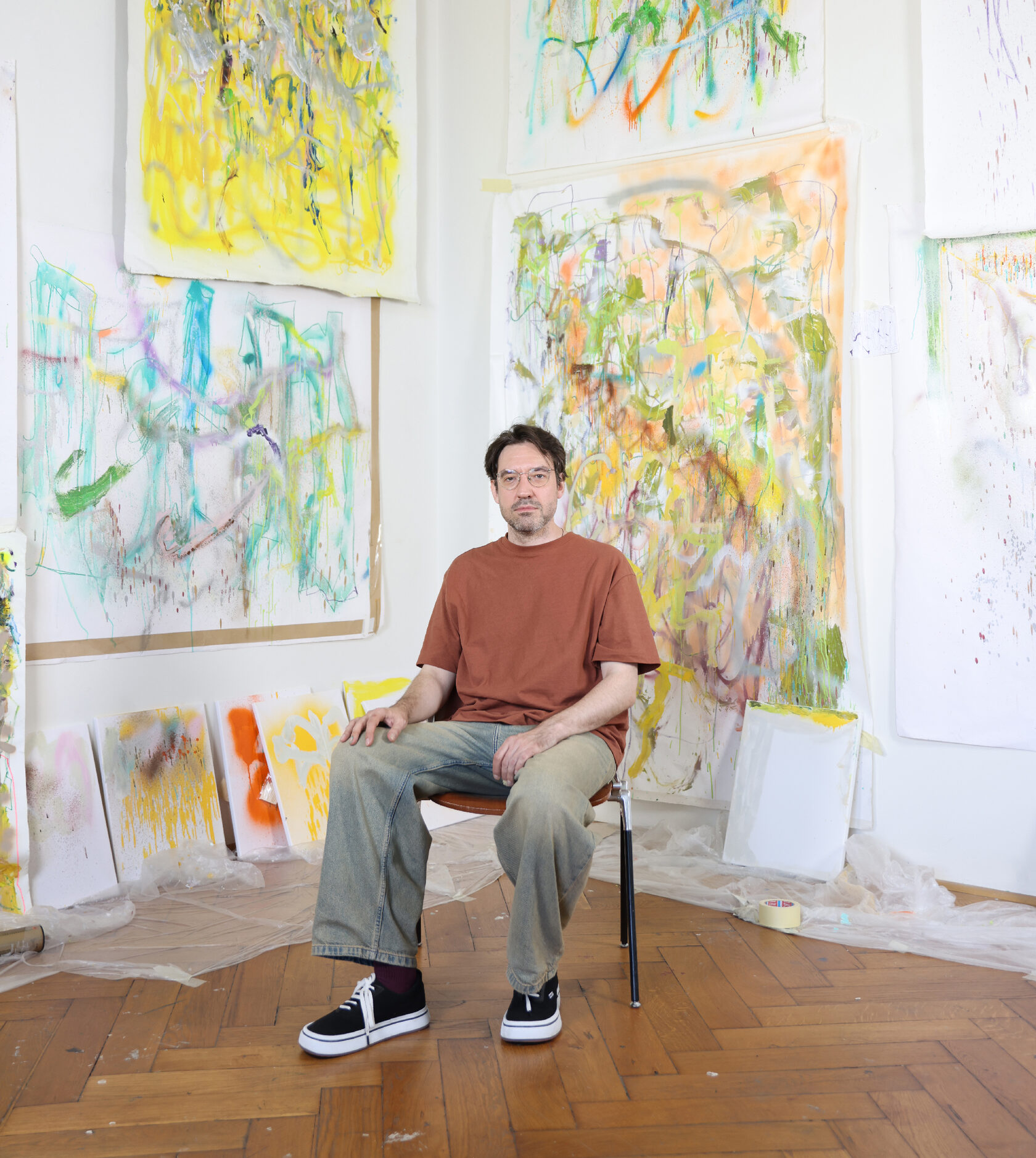
Oleg Ustinov is one of the representatives of the “noughties” generation, united by a nostalgia for twentieth-century modernism — a synonym for art itself. Modernism was then perceived as a completed project, one from which a critical distance was possible; a legacy to be re-engaged, to “re-open what has already been opened.” While in the 1990s the older generation of artists responded to drastic social changes, in the 2000s the reaction was directed against consumerism, glamour, and kitsch in a spirit of confrontation. The aim of these artists was to place the viewer in a state of uncertainty about what exactly they were seeing. They conceived of the viewer primarily as an active participant, someone who becomes themselves through the process of grappling with the material they encounter in dialogue with the work. This disruption of perception and the reinstallation of its “new settings” became a central motif in Oleg Ustinov’s practice.
The generation of the 2000s included many artists who came from Russia’s large regional cities. One of the main exporters of this “fresh blood,” just as it had been a decade earlier, was Rostov-on-Don. At that time, Oleg Ustinov was a student studying advertising and working in the city’s clubs together with his bandmates from “Zh & Ch” (“Zhaba & Chort” — “The Toad & the Devil”). Their work marked a new turn in a trajectory set in motion back in the 1980s by the art collective “Art or Death” (“Iskusstvo ili smert”). That group, whose members included future stars of Russian contemporary art like Valery Koshlyakov, Avdey Ter-Oganyan, and Yuri Shabelnikov, as well as lesser-known but locally iconic figures such as Nikolay Konstantinov, cultivated the image of the artist as a “holy fool” (yurodivy), embraced a deliberate roughness in execution, and, most importantly, staged exhibitions in overtly “anti-artistic” spaces. One such event was their “Provincial Avant-Garde” show held in Rostov-on-Don’s first cooperative public toilet. The toilet, named “Progress,” was declared a “cultural center” by the artists. Such actions directly inherited the legacy of Dadaism and punk aesthetics.
Oleg Ustinov also began his artistic path by appropriating unconventional, primarily public, spaces as part of the group Zh & Ch, using them to critique the consumerist excesses of the “prosperous 2000s.” The group’s members, who worked in the city’s glamorous restaurants, channeled their experience into their first series of art cards, titled Ustaff. These featured scenes of glamorously brutal tavern life, drawn on the back side of promotional postcards, accompanied by obscene rhymed couplets. The cards were distributed guerrilla-style in bars and in Rostov’s iconic club Podzemka. Even at this early stage, Ustinov distinguished himself as a master of text — his laconic verses were as provocative as they were merciless, but above all, honest and compelling, growing directly out of the artist’s life experience.
Amid a growing wave of critique against the surrounding “spectacle,” which tended toward increasingly subtle modes of expression, abstraction, which was by then considered “unfashionable” , began to regain its relevance. For many artists, and for Ustinov as one of its pioneers, it became a means of speaking about contemporaneity indirectly, as a consciously chosen strategy. Abstraction offered an effective way to position oneself in opposition to both the long-standing dominance of conceptualism and the actionism of the 1990s.
Oleg Ustinov became the first graduate of the Rodchenko School of Photography and Multimedia with a degree in painting. His greatest source of inspiration was American abstract expressionism. In the workshop of Sergey Bratkov, Ustinov explored the expressive possibilities of painting at its intersection with digital art including contemporary electronic music. For Ustinov, line became synonymous with melody. Echoing the well-known artist Erik Bulatov, who once claimed that in order to create a painting, all one needs are lines that generate spatial depth, Ustinov remarks: “I deepen the expressive power of line. With line alone, you can say everything, you can create a pictorial adventure without an open narrative. To me, this feels like the ultimate painterliness one can achieve with limited means.” In 2014, Ustinov took part in the 4th Moscow International Biennale for Young Art. That same year, his works were also exhibited in the show Don’t You Know Who I Am? Art After Identity Politics at the Museum of Contemporary Art in Antwerp.
Oleg Ustinov can be described as a multidisciplinary artist. In the abundance of his creative incarnations — painter, musician, writer, curator — he embodies the very type that critic Richard Kostelanetz once called a “polyartist”: a creative figure who succeeds across a variety of roles. His story is one of constant self-rebranding, a continuous search for identity as a personality in the making. An art-activist who puts up posters reading “David Lynch is our candidate” alongside the director’s photo on election billboards across Rostov. An anonymous chansonnier and brilliant songwriter, whose range stretches from hard-hitting social rap to queer poetry. A musically erudite performer capable, despite his largely virtual presence, of delivering electrifying live performances. He is the founder and curator of the gallery Llil.space in Rostov-on-Don, and a discoverer of new voices, such as Lyubov Kulik, an artist from Chechnya born in 1945. A brilliant mystifier, he is skilled at turning seemingly makeshift materials into layered statements, with layering being the very quality he himself emphasizes in his work. Sergey Bratkov once said of Ustinov: “A fiery voice that makes the pipes burn,” referring to Ustinov’s early installation of the same name, shown at Winzavod.
Today, Oleg Ustinov once again finds himself in the role of a student, this time at the Academy of Fine Arts in Vienna. Once again, he is learning to “unlearn how to draw,” as he did at the start of his career, having chosen the path of abstraction — and, in reality, the path of permanently reconstructing his own identity. A path of unstoppable, unending reinvention, of continually re-creating himself as an artist.
Konstantin Zatsepin
Solo exhibitions:
2025 — Slowed and Reverbed — PA Gallery, Moscow, Russia
2022 — Face-control — IRAGUI Gallery, Moscow, Russia
2021 — lll — llil.space, Rostov-on-Don, Russia
2021 — Road accidents (in collaboration with Ivan Gorshkov) — H.L.A.M. Gallery, Voronezh, Russia
2018 — Happy Hardcore (in collaboration with Egor Fedorychev) — Ovcharenko Gallery, Moscow, Russia
2018 — Liquid geometry — Studio of the Foundation of Vladimir Smirnov and Konstantine Sorokin, Moscow, Russia
2018 — Liquid jungle — Vladey Space, Moscow, Russia
2018 — Up to date — llil.space, Rostov-on-Don, Russia
2017 — Sentements — Rebus club, Rostov-on-Don, Russia
2016 — The Explosions — MSK Eastside Gallery/ISS MAG Gallery, Moscow, Russia
2015 — Still Moving (in collaboration with Sinead Breslin and Alexander Selivanov) — ISS MAG Gallery, Spiridonov’s House, Moscow, Russia
2013 — IDM — 16th Line Gallery, Rostov-on-Don, Russia
2012 — The Pipes Are Burning — Start Gallery, Winzavod, Moscow, Russia
2010 — “Not everyone will understand it, but I think art-critics will appreciate it” — Vata Gallery, Rostov-on-Don, Russia
2010 — Abstract Warriors (in collaboration with Alexander Selivanov and Alexey Khamov) — Museum of Contemporary Arts on Dmitrovskaya st., Rostov-on-Don, Russia
Group exhibitions:
2022 — X-Nowness — Basel Art Center, Bazel, Switzerland
2022 — Close. Far away. Closer — Victoria Gallery, Samara, Russia
2020 — Neoinfantilism — Name Gallery, Luda Gallery, DK Gromov, St. Petersburg, Russia
2017 — Toward the light house: the form and policy of light — PERMM Museum, Perm, Russia
2016 — Rodchenko Art School 10 years — 5th Moscow Biennale of Contemporary Art, parallel program, MAMM, Moscow, Russia
2015 — BALAGAN!!! The art from the Former Soviet Union and Other Mythical Places — Kunstquartier Bethanien & Max Liebermann Haus, Berlin, Germany
2015 — The Voices — Krasniy Art Center, Moscow, Russia
2015 — The Bomb, Krasniy Art Center — Moscow, Russia
2015 — Kiss My Magic, the Routine Psychedelia — ISS MAG Gallery, Moscow, Russia
2014 — The Fathers and The Sons — PERMM Museum, Perm, Russia
2014 — I have seen the lighting — Rodchenko School of Photography and Multimedia, Diploma exhibition, Udarnik exhibition center, Moscow, Russia
2014 — Time to dream — 4th International Moscow Biennale of Young Art, main project, Museum of Moscow, Moscow, Russia
2014 — Don’t you know who I am? Art after Identity politics — M HKA, Antwerp, Belgium
2014 — The Landscapes — Elektrozavod Gallery, Moscow, Russia
2014 — Extended Painting — Museum of Moscow, Moscow, Russia
2013 — VDNH — The Funnel — exhibiting hall of European Brittany Graduate School of Arts, Rennes, France
2013 — The M-4. Rostov-Moscow — Marat Guelman’s project Cultural Alliance Gallery, Moscow, Russia
2013 — Chicago (as part of PhSV group) — 8th Moscow Biennale Fashion and Style in Photography, Z urab Tsereteli Gallery of Arts, Moscow, Russia
2013 — The simulationists (as part of PhSV group), lection-performance What does the snoring want? — exhibition hall of Rodchenko School of Photography and Multimedia, Moscow, Russia
2012 — How is it done? — 2nd Ural Industrial Biennalle of Contemporary Art, parallel program, Ekaterinburg, Russia
2012 — Macaroni factory — Street Art Festival, Kick-art, performance at the opening, Rostov-on-Don, Russia
2012 — What does the snoring want? — Nikola Lenivets Art Residence, Kaluga region, Russia
2012 — The Pipes Are Burning — Regional project, “StartArt. Cultural Alliance” program, Live Perm Festival, Perm, Russia
2010 — Gop-Art — Live Perm Festival, Perm, Russia
2010 — Back in Goddamn (as past of The Toad and the Devil group) — Vata Gallery, Rostov-on-Don, Russia
2009 — Triumph (as past of The Toad and the Devil group) — Podzemka club, Rostov-on-Don, Russia
2009 — Flash (as past of The Toad and the Devil group) — Ruskomplekt, St. Petersburg, Russia
2009 — Troubles at work (as past of The Toad and the Devil group), Textura S tudio, Rostov-on-Don, Russia
2009 — The Fire Line (as past of The Toad and the Devil group) — Pillbox, Rostov-on-Don, Russia
2008 — Free Art action (as past of The Toad and the Devil group) at the square near — Don Public Library, Rostov-on-Don, Russia
2008 — “Why do we drink?” (as past of The Toad and the Devil group) — David Lynch Pub, Rostov-on-Don, Russia
2008 — Species of Fishes (as past of The Toad and the Devil group) — Region Museum of Local History, Rostov-on-Don, Russia
2008 — The dots (in memoriam of D. Prigov) (as past of The Toad and the Devil group) —
Museum of Contemporary Arts on Dmitrovskaya st., Rostov-on-Don, Russia
2007 — Exhibition #1 (as past of The Toad and the Devil group) — the basement
of Apartment #1, Rostov-on-Don, Russia
Residences and Grants:
2019 — Nemoskva project — finalist of the regional projects contest of the First Curatorial School The Art of the Document: Poetics of the Evidence
2016 — International Symposium of Contemporary Art Biruchiy — Biruchiy, Ukraine
2014 — International Symposium of Contemporary Art Biruchiy — Biruchiy, Ukraine
2013 — STRABAG Artaward, longlist — Vienna, Austria
2013 — The European Academy of Art in Brittany — Rennes, France
Curatorial projects:
2021 — Entrance to the passage — DaMoscow Art Show, special project, Moscow, Russia
2018 — llil.space Gallery, co-founder, curator, from 2018 to the present moment, rostov-on-Don, Russia
2015 —Kiss My Magic. The Routine Psychedelia — ISS MAG Gallery, Moscow, Russia
2014 — On the Cross — exhibition hall of Rodchenko School of Photography and Multimedia, Moscow, Russia
2009 — The Fire Line — Pillbox, Rostov-on-Don, Russia
2008 — “Why do we drink?” —David Lynch Pub, Rostov-on-Don, Russia
The generation of the 2000s included many artists who came from Russia’s large regional cities. One of the main exporters of this “fresh blood,” just as it had been a decade earlier, was Rostov-on-Don. At that time, Oleg Ustinov was a student studying advertising and working in the city’s clubs together with his bandmates from “Zh & Ch” (“Zhaba & Chort” — “The Toad & the Devil”). Their work marked a new turn in a trajectory set in motion back in the 1980s by the art collective “Art or Death” (“Iskusstvo ili smert”). That group, whose members included future stars of Russian contemporary art like Valery Koshlyakov, Avdey Ter-Oganyan, and Yuri Shabelnikov, as well as lesser-known but locally iconic figures such as Nikolay Konstantinov, cultivated the image of the artist as a “holy fool” (yurodivy), embraced a deliberate roughness in execution, and, most importantly, staged exhibitions in overtly “anti-artistic” spaces. One such event was their “Provincial Avant-Garde” show held in Rostov-on-Don’s first cooperative public toilet. The toilet, named “Progress,” was declared a “cultural center” by the artists. Such actions directly inherited the legacy of Dadaism and punk aesthetics.
Oleg Ustinov also began his artistic path by appropriating unconventional, primarily public, spaces as part of the group Zh & Ch, using them to critique the consumerist excesses of the “prosperous 2000s.” The group’s members, who worked in the city’s glamorous restaurants, channeled their experience into their first series of art cards, titled Ustaff. These featured scenes of glamorously brutal tavern life, drawn on the back side of promotional postcards, accompanied by obscene rhymed couplets. The cards were distributed guerrilla-style in bars and in Rostov’s iconic club Podzemka. Even at this early stage, Ustinov distinguished himself as a master of text — his laconic verses were as provocative as they were merciless, but above all, honest and compelling, growing directly out of the artist’s life experience.
Amid a growing wave of critique against the surrounding “spectacle,” which tended toward increasingly subtle modes of expression, abstraction, which was by then considered “unfashionable” , began to regain its relevance. For many artists, and for Ustinov as one of its pioneers, it became a means of speaking about contemporaneity indirectly, as a consciously chosen strategy. Abstraction offered an effective way to position oneself in opposition to both the long-standing dominance of conceptualism and the actionism of the 1990s.
Oleg Ustinov became the first graduate of the Rodchenko School of Photography and Multimedia with a degree in painting. His greatest source of inspiration was American abstract expressionism. In the workshop of Sergey Bratkov, Ustinov explored the expressive possibilities of painting at its intersection with digital art including contemporary electronic music. For Ustinov, line became synonymous with melody. Echoing the well-known artist Erik Bulatov, who once claimed that in order to create a painting, all one needs are lines that generate spatial depth, Ustinov remarks: “I deepen the expressive power of line. With line alone, you can say everything, you can create a pictorial adventure without an open narrative. To me, this feels like the ultimate painterliness one can achieve with limited means.” In 2014, Ustinov took part in the 4th Moscow International Biennale for Young Art. That same year, his works were also exhibited in the show Don’t You Know Who I Am? Art After Identity Politics at the Museum of Contemporary Art in Antwerp.
Oleg Ustinov can be described as a multidisciplinary artist. In the abundance of his creative incarnations — painter, musician, writer, curator — he embodies the very type that critic Richard Kostelanetz once called a “polyartist”: a creative figure who succeeds across a variety of roles. His story is one of constant self-rebranding, a continuous search for identity as a personality in the making. An art-activist who puts up posters reading “David Lynch is our candidate” alongside the director’s photo on election billboards across Rostov. An anonymous chansonnier and brilliant songwriter, whose range stretches from hard-hitting social rap to queer poetry. A musically erudite performer capable, despite his largely virtual presence, of delivering electrifying live performances. He is the founder and curator of the gallery Llil.space in Rostov-on-Don, and a discoverer of new voices, such as Lyubov Kulik, an artist from Chechnya born in 1945. A brilliant mystifier, he is skilled at turning seemingly makeshift materials into layered statements, with layering being the very quality he himself emphasizes in his work. Sergey Bratkov once said of Ustinov: “A fiery voice that makes the pipes burn,” referring to Ustinov’s early installation of the same name, shown at Winzavod.
Today, Oleg Ustinov once again finds himself in the role of a student, this time at the Academy of Fine Arts in Vienna. Once again, he is learning to “unlearn how to draw,” as he did at the start of his career, having chosen the path of abstraction — and, in reality, the path of permanently reconstructing his own identity. A path of unstoppable, unending reinvention, of continually re-creating himself as an artist.
Konstantin Zatsepin
Solo exhibitions:
2025 — Slowed and Reverbed — PA Gallery, Moscow, Russia
2022 — Face-control — IRAGUI Gallery, Moscow, Russia
2021 — lll — llil.space, Rostov-on-Don, Russia
2021 — Road accidents (in collaboration with Ivan Gorshkov) — H.L.A.M. Gallery, Voronezh, Russia
2018 — Happy Hardcore (in collaboration with Egor Fedorychev) — Ovcharenko Gallery, Moscow, Russia
2018 — Liquid geometry — Studio of the Foundation of Vladimir Smirnov and Konstantine Sorokin, Moscow, Russia
2018 — Liquid jungle — Vladey Space, Moscow, Russia
2018 — Up to date — llil.space, Rostov-on-Don, Russia
2017 — Sentements — Rebus club, Rostov-on-Don, Russia
2016 — The Explosions — MSK Eastside Gallery/ISS MAG Gallery, Moscow, Russia
2015 — Still Moving (in collaboration with Sinead Breslin and Alexander Selivanov) — ISS MAG Gallery, Spiridonov’s House, Moscow, Russia
2013 — IDM — 16th Line Gallery, Rostov-on-Don, Russia
2012 — The Pipes Are Burning — Start Gallery, Winzavod, Moscow, Russia
2010 — “Not everyone will understand it, but I think art-critics will appreciate it” — Vata Gallery, Rostov-on-Don, Russia
2010 — Abstract Warriors (in collaboration with Alexander Selivanov and Alexey Khamov) — Museum of Contemporary Arts on Dmitrovskaya st., Rostov-on-Don, Russia
Group exhibitions:
2022 — X-Nowness — Basel Art Center, Bazel, Switzerland
2022 — Close. Far away. Closer — Victoria Gallery, Samara, Russia
2020 — Neoinfantilism — Name Gallery, Luda Gallery, DK Gromov, St. Petersburg, Russia
2017 — Toward the light house: the form and policy of light — PERMM Museum, Perm, Russia
2016 — Rodchenko Art School 10 years — 5th Moscow Biennale of Contemporary Art, parallel program, MAMM, Moscow, Russia
2015 — BALAGAN!!! The art from the Former Soviet Union and Other Mythical Places — Kunstquartier Bethanien & Max Liebermann Haus, Berlin, Germany
2015 — The Voices — Krasniy Art Center, Moscow, Russia
2015 — The Bomb, Krasniy Art Center — Moscow, Russia
2015 — Kiss My Magic, the Routine Psychedelia — ISS MAG Gallery, Moscow, Russia
2014 — The Fathers and The Sons — PERMM Museum, Perm, Russia
2014 — I have seen the lighting — Rodchenko School of Photography and Multimedia, Diploma exhibition, Udarnik exhibition center, Moscow, Russia
2014 — Time to dream — 4th International Moscow Biennale of Young Art, main project, Museum of Moscow, Moscow, Russia
2014 — Don’t you know who I am? Art after Identity politics — M HKA, Antwerp, Belgium
2014 — The Landscapes — Elektrozavod Gallery, Moscow, Russia
2014 — Extended Painting — Museum of Moscow, Moscow, Russia
2013 — VDNH — The Funnel — exhibiting hall of European Brittany Graduate School of Arts, Rennes, France
2013 — The M-4. Rostov-Moscow — Marat Guelman’s project Cultural Alliance Gallery, Moscow, Russia
2013 — Chicago (as part of PhSV group) — 8th Moscow Biennale Fashion and Style in Photography, Z urab Tsereteli Gallery of Arts, Moscow, Russia
2013 — The simulationists (as part of PhSV group), lection-performance What does the snoring want? — exhibition hall of Rodchenko School of Photography and Multimedia, Moscow, Russia
2012 — How is it done? — 2nd Ural Industrial Biennalle of Contemporary Art, parallel program, Ekaterinburg, Russia
2012 — Macaroni factory — Street Art Festival, Kick-art, performance at the opening, Rostov-on-Don, Russia
2012 — What does the snoring want? — Nikola Lenivets Art Residence, Kaluga region, Russia
2012 — The Pipes Are Burning — Regional project, “StartArt. Cultural Alliance” program, Live Perm Festival, Perm, Russia
2010 — Gop-Art — Live Perm Festival, Perm, Russia
2010 — Back in Goddamn (as past of The Toad and the Devil group) — Vata Gallery, Rostov-on-Don, Russia
2009 — Triumph (as past of The Toad and the Devil group) — Podzemka club, Rostov-on-Don, Russia
2009 — Flash (as past of The Toad and the Devil group) — Ruskomplekt, St. Petersburg, Russia
2009 — Troubles at work (as past of The Toad and the Devil group), Textura S tudio, Rostov-on-Don, Russia
2009 — The Fire Line (as past of The Toad and the Devil group) — Pillbox, Rostov-on-Don, Russia
2008 — Free Art action (as past of The Toad and the Devil group) at the square near — Don Public Library, Rostov-on-Don, Russia
2008 — “Why do we drink?” (as past of The Toad and the Devil group) — David Lynch Pub, Rostov-on-Don, Russia
2008 — Species of Fishes (as past of The Toad and the Devil group) — Region Museum of Local History, Rostov-on-Don, Russia
2008 — The dots (in memoriam of D. Prigov) (as past of The Toad and the Devil group) —
Museum of Contemporary Arts on Dmitrovskaya st., Rostov-on-Don, Russia
2007 — Exhibition #1 (as past of The Toad and the Devil group) — the basement
of Apartment #1, Rostov-on-Don, Russia
Residences and Grants:
2019 — Nemoskva project — finalist of the regional projects contest of the First Curatorial School The Art of the Document: Poetics of the Evidence
2016 — International Symposium of Contemporary Art Biruchiy — Biruchiy, Ukraine
2014 — International Symposium of Contemporary Art Biruchiy — Biruchiy, Ukraine
2013 — STRABAG Artaward, longlist — Vienna, Austria
2013 — The European Academy of Art in Brittany — Rennes, France
Curatorial projects:
2021 — Entrance to the passage — DaMoscow Art Show, special project, Moscow, Russia
2018 — llil.space Gallery, co-founder, curator, from 2018 to the present moment, rostov-on-Don, Russia
2015 —Kiss My Magic. The Routine Psychedelia — ISS MAG Gallery, Moscow, Russia
2014 — On the Cross — exhibition hall of Rodchenko School of Photography and Multimedia, Moscow, Russia
2009 — The Fire Line — Pillbox, Rostov-on-Don, Russia
2008 — “Why do we drink?” —David Lynch Pub, Rostov-on-Don, Russia